2-2004
Biography
MEPRAL - THE ANCESTRAL VILLAGE OF POOTHICOTE FAMILY
Roy P. Thomas, MD.
"Tell me where you are from and I will tell you who you are" - Saul Bellow
Mark Twain once said that he wants to be in Cincinnati when the world ends, because every thing in Cincinnati happens 10 years later. It is much truer of Mepral, my father's ancestral village in Kerala, every thing there also happens often several decades later.
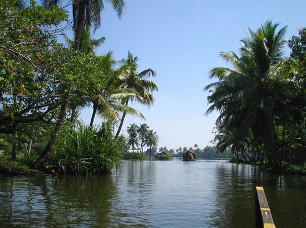
Mepral is a 1.9 square miles of land situated on either side of the small Mepral River which is a branch of one of the tributaries of the Pumpa River. It juts in to the huge water-logged paddy fields which extend up to the Vampanda Lake on its northern side. It is to this river, soil, and to the people here that I am ancestrally linked. My ancestors came to this village in the early part of the 18th century and were living here for 300 years since they moved here from Kuravilagad, a northern village in Kerala.
Before King Marthanda Varma unified the small principalities in 1729 to form Travancore, Mepral was part of Thekkumkur kingdom, and Azhiyidathu Prabhu was the chieftain here. Before the advent of modern automobiles, country boats were the chief mode of transportation and lands closer to the rivers were the most valuable. Mepral, with rivers and canals crisscrossing the land, became a major attraction for the rich and powerful in the earlier centuries.
Mepral was the center of my universe for the first 14 years of my life till I left for college. It may have been a poor place to prepare one for the 21st century, but was a delightful place to spend the childhood with friends and relatives.
Then it was an agrarian-world where tribe and territory were very important. Our family owned a major share of agricultural property in Mepral. People were deeply rooted in their rural feudal values. Even in 1950s, people in Mepral had little in common with their contemporaries in London, Chicago, or even most other cities in India. We were still innocent of the many basic innovations of the industrial revolution. It was only 100 years after their inventions that electricity, indoor plumbing, and telephones made their appearance in our village. I was 12 years old, when the first railway lines connected our part of Kerala with the rest of the country. Though motor engines came to Mepral in 1920, even in 1950s, people were using chakrams, the huge wooden water wheels operated by several men with their feet to irrigate the paddy fields. Wooden plows, drawn by 2 oxen or buffalos guiding along the furrows in the field by bare-legged workers were a common sight even in 1960s. All our food was produced locally.
As there was no running water, my mother or our servants hauled water from the well every day with a bucket for use at home and they washed our clothes in the near by river. I studied by the light of kerosene lamp till I went to college. We lighted the oil lamp every evening and all the family got around the lamp and said our evening prayers. Even as a child I loved reading in bed, and usually I went to sleep with kerosene lamp burning near my bed. My father would walk slowly in to the room without disturbing my sleep to blow of the lamp.
My father's house in Mepral was made of brick and wood. Most houses had thatched roofs, and 99% of the people in Mepral never traveled beyond 100 miles from their home in their lifetime. In fact, people never moved out from this place except when they died. No hospitals, no police stations, and no doctors. The village still seemed to be in the middle-ages though I was spending my childhood there in the middle of the 20th century.
Mepral is situated in the middle of Kerala state, in an area called Kuttanad. In the ancient South Indian language, "Me" stands for west and "pral " for land and so Mepral means western land. It was all sea here in the not too distant geological past. This area, like Denmark is under the sea level. During November or December, a narrow raised bond over its outer lake borders is built by people to prevent seawater flowing in. In this temporary dry land thus created, rice was cultivated. Most of the present houses in Mepral are built on land reclaimed from water-logged paddy-fields. Several of our house names like Paikandam, Nanchenkandan, and Kolankandam denotes they are located on reclaimed paddy-fields.
During floods that regularly visit 2 or 3 times every year in the monsoon season, Kuttanadu is covered with water except for some raised land areas. In a severe rainy season, there used to be water in our family rooms, bedrooms, and kitchen. Then we moved our cooking and sleeping to Ara, which was a raised, wooded room at a higher level. Other times, Ara was reserved as a barn for storing harvested rice grains.
Because of these frequent floods, every one in our village learned swimming early in their childhood. I don't remember when I learned to swim because I mastered it before my memories started.
As there was water everywhere, people generally didn't use footwear and the first time I ever used shoes was when I went to college. When the monsoon floods receded, house floors were given a fresh coating of cow-dung. Cow-dung was considered to have antiseptic cleaning powers. Cement or concrete were rarely used for floors as it frequently got wet and damaged during the floods.
The nature, rivers, and rains gave a natural rhythm to the life of villagers. Every morning, I used to wake up to the sound of the nature's orchestra of parrots, minas, crows, fowls, chickens, and ducks. Even teals used to fly thousands of miles from Siberia to join us in our merriment of the harvest season.
Most of the work in the rice fields was in the summer months of December to April. The rest of the year people leisurely tended to family, community, or church activities, and other recreational pursuits. Fishing was fun for the rich but a livelihood for the poor. The large prawns (Mepral konchu) from our rivers were well known in central Kerala. Boat racing was a common recreation for all. People sang special songs when they were racing boats called vanchipattu. But there were special songs for every occasion.
Everything one owned could be lost in a flood. So people became fatalistic and deeply religious. There were special prayers in the books for every calamity one can think of like floods, locust in the land, or epidemics.
Still rays of modernity were showing its glimpses in the horizon. My preschool education started at home when I was 3 years old. An old teacher called Manikandhan Ashan used to come to our house to teach me Malayalam alphabets and basic numbers. On the first day he made me write with my fingers on rice grains spread over the floor and later on sand. I often sat on his lap as I was writing. The first words I wrote were praise to Hindu gods of learning, but next, in deference to the religion of my parents, he made me write "Sree yeasu vijayam" , meaning victory for Jesus. The Ashan wrote homework to read on dried palm leaves with a sharp iron pencil. I had heard horror stories that Ashan may not mind to use the sharp edge of the iron pencil on the buttocks of the students if we they did not keep up with the homework. But Ashan was very kind and nice to me. May be, it was because my mother prepared pootu, the rice steam bread, for the Ashan which he relished eating at the end of each teaching session.
I joined the regular school when I was 4 years, one year earlier than the regular enrollment because I had learned all Malyalam alphabets by that time, and my parents were eager to start my education at the earliest. They may not have heard of the advantages of head-start, but they started my education sufficiently early. There were 3 primary schools in Mepral. The one most children attended was called Ashupatri pallikoodam, the name meant hospital school. It was called so because the building when it was originally built in 1921, it was for a hospital. But they could not get a doctor to come and practice in our remote village, and so it was turned into a school.
I still remember my first day in this school. It was 1947 and Indian independence struggle was in full swing. As we were sitting in school, volunteers of the Indian National Congress Party came wearing white Gandhi caps and Indian tricolor flags in their hands. They asked us to join independence struggle against the British colonial rulers by boycotting the school. Many children started crying. I did not understand what this commotion was all about. My father came and took me home. That was my first and only participation in the Indian independence movement.
I never again went to the same school. I was sent to another private school in our village run by the Salvation Army. Here dicipline was stricter and no participation in freedom struggle allowed. This was a school run mainly for the untouchable Pulayas, Pariahs, Ezhavas, and Christian boys from poor homes. I was perhaps the only child in the school who had any claim to a high birth. I wore a trouser reaching up to the knees and a sleeveless cotton shirt. I was the only one who wore shirts over the trunk in that school. The other children wore only small loincloths. I was much respected and looked up to in the class because I was from a "rich" aristocratic Syrian Christian family. Many of the other student's parents worked in our farms. My richness was of course relative. Actually our family belonged to the middle class and unlike many others during that period, we were prosperous enough to afford 3 meals a day. There were two other classes below us, lower middle class, and the poor. The lower middle class was mainly Christians from less well known families, and then Nairs, and Ezhavas who worked in our farms. This class also included craftsmen, smiths and other skilled labors. The lowest poor class was the untouchable pulayas who worked in our paddy fields. My best childhood friends were these pulaya children. Most of these bare chested dark skinned children dropped out after 2 or 3 years of schooling to take up work in the rice fields and helped their parents. I did not have any toys to play with, no music to listen to, and no children's book to read. Fishing, climbing trees, swimming in rivers with those poor children were my recreation and even now I treasure those memories.
After primary school I continued my education in the St. John's Middle School, the only English school in Mepral started by a great visionary, the Very Reverend Kanianthra Alexander Corepiscopa in the second decade of the 20th century.
Sex was a subject never discussed by cultured people in our community. We were taught about the breeding of the animals and the pollination of the plants. But how the human beings propagated the species remained a mystery to me till much later, and the information was given to me by a friend during my senior years in school. Kissing was a taboo and men and women of that generation did not kissed each other in public. There are no movie theatres in Mepral even today. There were occasional dramas shown in schools, but always men dressed as women acted the female roles. The Onam, the Kerala harvest festival was always celebrated with gusto in the month of September.
.
In the feudal system prevalent at that time, any one who owned land was considered rich. There were 3 rich well known landowning families in Mepral, Poothicote, Manammel, and Kaniyanthra, and we were all interrelated through marriages. So I had legions of cousins, and bonds with cousins even 5 times removed were very strong.
Then there were other Christian families like Kolath, Plamood, Panagad, Panickerveetil, and Panachayil who were already in Mepral even before our ancestors moved over there, but we dominated the social and economic spheres of the village during that time. The Nair families of Erikad, Puthupally, Kayilath and Vachur, Ezhava families of Valliyaparampil and Pulliyattu Panickers, and Brahmin families of Kizhakkamadham and Padinjaramadham were also living in Mepral for several generations. There were always extremely cordial relations among different religious communities in our village.
But how rich our family really was? Even if we didn't have a lot of money, we were supposed to dress well and act rich. During those post World War II years, there were lot of poverty all around the world, but more so in the remotest areas like ours. Our staple diet was rice, and because we cultivated it, there was no scarcity for rice to eat. From our rivers, we could catch fish, and with coconuts grown in our own lands, women made delicious dishes to go with the rice.
The Portuguese merchants brought wheat bread to Kerala in 1500. The place where bread is made is still known by its Portuguese name "borma". But wheat was not cultivated in our area and the bread was a luxury those days in our village. There was an old man coming to our village with bred in a basket carried over his head. Occasionally my mother will buy bread for us and it was considered a treat.
During those pre-refrigeration days, people were careful about the amount cooked each time. Only enough food was cooked for the day so that the food was not wasted. Excess food was always distributed to the neighbors or servants. Beef was served only few times a year like for Christmas and Easter when cows were slaughtered in the village. Every house was a small chicken farm. When guests visited us, we ran after squawking chickens to catch and behead them to make fresh chicken curry. I always liked guests, because then we could also get the sumptuous chicken curry. Eggs laid by the hens were often bartered for kitchen utensils and dry salted sardines brought by merchants from the sea. We owned cows and buffalos to give milk and oxen to plough our paddy-fields. Those animals were more like members of our family than livestock.
Though my mother did all the work at home, the supremacy of the mother-in-law was accepted in all matters as was the custom. At my grandmother's funeral, our priest referred to my mother as a modern day Ruth, the biblical Old Testament figure who loved and obeyed her mother-in-law. My mother loved and took care of my grandmother as she grew old and suffered from advanced Alzheimer's disease. My mother was her sole caregiver, and she never uttered a word of complaint, or gave the slightest sign that she was unhappy with the household drudgery. In our custom, a woman was not only married to a man, but she was married in to the family of her husband.
All marriages in the village were arranged marriages, and most of them worked out well, but occasionally I have seen instances where two people got married and then they lived with a lively aversion for each other for the rest of their lives.
My grandparents were good and loving souls. My grandmother's earlobes were large holes, stretched by heavy gold ear rings adorned in her younger years, evidence of an era of prosperity and affluence. When we children did little mischief, grandma used to protect us form the punishments of our parents. Once after I did some mischief, I was running as my father came after me with a stick in his hands. I ran in to my grand mother's arms as she was standing outside the house. Ammachi fell to the ground and broke her wrist.
My grandfather was a stout healthy man even in his eighties, and he could do hard physical work for hours without getting tired. He had rough callused hands, but a gentle affectionate touch with those hands was more effective in reducing any fever or pain for his grandchildren than any medicines.
The families stored the grains and sold it in the months when price was high. We got some extra money by selling coconuts, but never enough for all our needs.
After the dinner every day, my father and grandfather strolled in the porch for two hours and used to reminiscence the good old days, when life was bright and sunny. More than being a father and son, they were best friends. I have often wondered what they had to talk this long every day as nothing new happened in Mepral in ages. But they talked about the farms, weather, politics, religion and everything under the sun.
There was a strong bond between the pulaya workers and our family. One of the surviving members of the pulaya clan that served my family is Kochukunju. Even now when I return to India, he comes and stays with us. He has told me that his great-great-great-grandfather was a bonded worker bought by my great-great-great-grandfather. Slavery was abolished in Kerala in 1812. Still Kochukunj's family took care of our farmlands and stayed with us. There was a lot of poverty and hunger around us. But our family treated our workers well and provided them food and shelter at all seasons. Kochukunj's is a converted Christian. Still we did not allow him and his people to join our churches as ours was strictly for the Syrian Christians following the St. Thomas tradition. But we supported the churches of pulayas. Even after coming to America, my brothers and I used to financially help Kochunkunju. Now Kochukunju is nicknamed American Kochukunju by his neighbors.
The only government office in our village was the post office and my father was the postmaster there. On days my father had to supervise the workers in our fields, my mother performed the duties of the postmaster. Post master's monthly salary was Rs.15 from the British government, as postal service was under them. Post office handled mail from outside the state and local mail was carried by a service called "anchelappice" under the local government. Anggelapese had a much lower status than the post office. In 1950, when Indian republic came in to existence, these two offices were combined, and my father resigned rather than being assigned to another locality.
The longest travel I ever made as a child was to Kottayam, a town 19 miles away from my home. It was my first glimpse to the outside world. It was the time a young American preacher named Billy Gram was there giving sermons. There was a large crowd to listen Gram and I had never before seen such a big crowd. My father took 5 Rupees and wrote down on a piece of paper the address of his sister in Kottayam and put both in my pocket. He told me that in case I got lost in the crowd, he wanted me to take a "rikshavandi" and go to my aunt's house. I never got lost and kept on holding my fathers hand very firmly. But I didn't understand anything Rev. Gram was speaking but he saved many souls on that day, at least that is what I was told.
A word about "rakshavandi". It was a mode of transportation where lean poor miserable looking men physically pulled fatty prosperous men or women in a cart to their destinations. Very often these "raksha pullers" died of tuberculosis and malnutrition. The socialist leaning congress party government of Jawaharlal Nehru in late nineteen-fifties outlawed "rakshavandi".
I can remember of only 2 serious illnesses from my childhood. One was when I had a severe sore throat followed by terrible fleeting pain in all my joints. I could not walk or sit with because of excruciating pain. I will remember to the last day of my life, how my father affectionately held me in his lap, day and night soothing my joints with Ayurvedic herbal ointments. I know now it was rheumatic fever. Rheumatic fever usually licks the joints and bites the heart. But in spite of the primitive herbal treatments I received, I survived with out my heart getting bitten.
The other illness was an attack of chicken pox. Though smallpox was eradicated in our area following universal vaccination, it was still in the memory of old people. I have heard about the deadly rampage of smallpox in our village from my grandfather. People were very frightened of the disease and no help was available even to bury those who died in hundreds. There was a superstitious belief that the local Ayurvedic physicians could make corpses of people died of smallpox walk to their graves. There is a horrible possibility that as there were no close relatives near the patient, the physician made the people who were about to die walk to their own graves and then he waited near the grave for the death to come.
When I had chickenpox, my local ayurvedic physician mistook it with smallpox. He undertook my full time care. I was visited by my father and grandfather; but I was isolated from everybody else. I remember that my physician was always drunk, and he even offered me one day toddy, the local alcoholic drink, and told me that it was good for my condition. So I had my first alcoholic drink for medical reasons under professional supervision. My father and grandfather were teetotalers. But on my mother's side everybody enjoyed a drink or two, and at least two of my maternal uncles enjoyed it a little too much or till they lost their motor and cerebral controls before the bars closed.
Though these are the only two serious illnesses I can remember from my childhood, today serology report of my blood shows that I had measles, mumps, whooping cough, hepatitis A, and many other illnesses which I survived only by the grace of God.
Though death made house calls for the young and the old regularly in our village, nobody tried to camouflage it. There were no hospitals or funeral homes in our village to hide the obscenity of death. Death was always a family matter happening in the presence of the family and friends.
I remember the death of my grandfather at the age of 90. He planed the details of his funeral with the family. As the day of his departure finally arrived, he called each member of the family near to his bed. He blessed each one of us by placing his hand over our head. Then he breathed his last. His death was painful to all of us, but his funeral was a celebration of a great life.
I had tutor, Annamma teacher, who came to our house on all weekdays at 7 am and gave me and my sister special tuition. Her fee was only Rs. 6 a month, but more than the money, she appreciated the morning breakfast of rice gruel known as "kanji" , as she came from a poor family. Those tuitions were a head start for my sister and me in academic achievements. My headmaster, Purackel Mammen sar was also very affectionate to me, and during rainy days he carried me in his shoulders to the school. He was our family friend and owned paddy-fields near ours.
One day my father's younger brother "Chackochen appappan" came running home crying and shouting, "Gandhi is shot and killed." Though I was only 6 years old then, I had heard the name Gandhi before, but I did not know who he was.
During this period, another one of my father's brother, Cherian wrote to us from Singapore that he had survived as a Japanese prisoner of war and was now free and working for a British company as a senior supervisor. He is one of the few individuals from Mepral who dared to leave our village and try to make a living in another country. He left Kerala when he was 18 years old and spent the next 70 years in Johore in Malaysia with his children and grand children, but always made sentimental journeys back to Mepral when ever he could.
I never got any gifts for my birthdays. It was not a custom and my parents could not afford costly gifts. But on my birthdays my parents used to invite 12 poor kids from our locality and gave them a feast of payasm, a special rice desert made for such occasions. Looking back, I did not have gifts, but loving parents and grand parents made up for every thing that was missed. In fact those were the happiest years of my life.
I visit Mepral every year since I left the country 35 years ago. Even today I feel I was blessed to be born in the Poothicote family as the son of Kunjukunju and Kunjamma, and grandson of KunjuVarkeyachen and Achiyamma in Mepral.
But now, every year on my return visits, I find to my dismay that the life as it was lived for hundreds of years in our village is disappearing very fast. Even the Mepral River, which was very clean and transparent and where I used to take bath in the morning and evening, has changed with the times, and I do not feel comfortable taking a bathe in it now. As the green revolution has taken hold, it is cheaper for people in Mepral to import rice grains from other places than to cultivate it themselves. High cost of labor is making farming here prohibitively expensive. Many among our new generation have already left Mepral looking for better pastures elsewhere.
Now when I go back to Mepral, I feel like an emissary from a world which is no longer there. Even my cousins who are still living in Mepral do not follow our old ancestral ways of life. They too go for fast foods, wear clothes from Gap, watch CNN for news, and keep in touch with me via email.